Showing posts with label common knowledge. Show all posts

Friday, June 17, 2011

What happens in "The Bell Jar"?


Search
: bell jar

Why: In Ryan O'Connell's essay "How to See a Shrink" on Thought Catalog:
Experience a kind of depression you’ve never felt before. Live in the bell jar, cry during commercials in the middle of the afternoon when the sun is still shining and people are outside living their lives. Or just have lots of money and like to talk about yourself. Decide to call a therapist.
I never read that book, and I don't think I want to.

Answer: Oh, it has much more narrative than I suspected. Here is a summary of the summary:
Esther Greenwood, a girl from Boston, gets a summer internship at a magazine in NYC. She is not as excited as she feels like she's supposed to be, just kind of meh about the whole thing. She has a bitchy friend Doreen, and knows a baby-machine idiot named Dodo, but she respects Betsy from Kansas who is always good and nice.

Esther goes to her job and things happen. She has a beau back home who she expects to marry. She thinks a lot about Julius and Ethel Rosenberg, those communists who are scheduled for execution. She applies for a writing course by a famous author, but when she goes home, her seaward of a mom tells her she was rejected. She wants to write a novel, but she doesn't think she knows anything. After school, she doesn't want to pop out babies like Dodo or be a stenographer like all the other women of America, and the idea of not being able to do anything else bums her out.

Esther's depression makes her unable to asleep. Her mother sends her to a hot psychiatrist who Ester does not trust. He hastily diagnoses her and has her put in a hospital, where she receives electroconvulsive therapy that's is improperly administered. When she tells her mom she doesn't want to go back, her mom is all, "I knew you'd decide to be all right."


Esther gets more and more blue. She feels like she's trapped under a bell jar, struggling for breath. She half-asses some suicide attempts, and after a particularly elaborate one, she is sent to a different hospital. She is given a lady therapy, Dr. Nolan, who gives her psychotherapy and ECT done the right way.

Esther confides in Dr. Nolan that she envies the freedom men have, and that she worries about getting pregnant. Dr. Nolan hooks her up with a diaphragm, which makes Esther feel less scared about sex and having to marry the wrong man. She improves a lot, and the novel ends with her entering the room for an interview that will decide whether she can leave the hospital.
Esther.

Source
: Wikipedia

The More You Know: The real reason I am posting this is because I just read a ton about Sylvia Plath (b. 1932) who kilt herself at age 30. Points of interest:
  • Almost all of the major plot points in The Bell Jar really happened to her.
  • She married English poet Ted Hughes on 6/16/56.
  • They had 2 kids, Frieda (b. 1960) and Nicholas (b. 1962).
  • In Aug. 1961, she finished The Bell Jar.
  • In July 1962, she discovered her husband having an affair with Assia Wevill, who was renting their flat in London with her [third] husband David. The couple separated.
  • In Oct. 1962, Plath wrote most of the poems in Ariel (published posthumously).
  • In Dec. 1962, she rented a flat in William Butler Yeats's old house with her two kids. It was cold and miserable; the kids were sick all the time, and she didn't have a phone.
  • In Jan. 1963, The Bell Jar came out, published under the pen name Victoria Lucas, and was met with critical indifference.
  • Plath's friend Dr. Horder saw that she was not doing well, and he prescribed her anti-depressants and arranged for her to have a live-in nurse.
  • On Feb. 11, 1963, Plath put wet towels under the doors of her children's rooms and stuck her head in the oven. She died of carbon monoxide poisoning.
  • At the time of Plath's suicide, Assia Wevill was pregnant with Hughes's child, but she terminated the pregnancy soon after. She helped Hughes care for Plath's children.
  • In March 1965, Wevill gave birth to a daughter nicknamed Shura while still married to David Wevill. Though Hughes never publicly claimed Shura was his daughter, he believed she was his.
  • On March 23, 1969, Wevill gassed herself and 4 year-old Shura in their London home using a gas stove. The two were found lying on a mattress.
  • In Oct. 1998, Ted Hughes died of a heart attack.
  • On March 16, 2009, Nicholas Hughes hanged himself at age 47.
#dark

Plath in photos: Cape Cod 1952, in Paris

Thursday, April 14, 2011

What's a Flip Flap?


Search
: flip flap

Why: This was one person's answer to a survey question:
2. do you have pets or plants, details please? if not, do you want pets or plants?
2 cats and a Flip Flap.
Answer: A solar-powered Japanese toy plant thing! They really have thought of everything. Check out what these bad boys can do!
Source: YouTube

The More You Know: But wait, that's not all!
Actually, I guess it does more than a real plant. I want one.

Friday, April 8, 2011

What are pigeon houses?


Search
: pigeon houses

Why: In this collection of aerial photography by Yann Arthus-Bertrand:
Pigeon Houses Mit Gahmr Delta, Egypt
Answer: Well, they are houses for pigeons! But why? Because:
Pigeon is a part of the daily diet in many parts of Egypt
Horf! Also, they use the droppings as fertilizer. The houses, called dovecotes, are made of natural mud brick.
Source: EarthArchitecture.org

The More You Know: Other interesting images from that collection:

Sha Kibbutz, Israel
Copenhagen, Denmark
Denver, Colorado

What's the origin of the word "chauvinist"?


Search
: chauvinist etymology

Why: I can't remember exactly, but Jessica Fletcher used that word last night, but not in a mean way. That makes me think it has a more complicated definition than the way Jessie Spano always spat it out.
Answer: It comes from a guy named Nicolas Chauvin! He was a soldier in Napoleon's Grande Armée, legendary for his loyalty even after being wounded 17 times, maimed and disfigured. He was eventually ridiculed during the Restoration because people hated Napoleon. He also might not have really even existed.

Anyway, in the 1840s, the word "chauvinism" came to mean "a exaggerated, bellicose patriotism" or "a belief in national superiority and glory" - kind of like jingoism. It wasn't used in conjunction with "male" to mean "thinks boys are better than girls" until the 1960s, when wimmens were all in an uproar about how they were being treated.

Source: EtymOnline, Wikipedia

The More You Know: There are female chauvinist pigs, too, though. They are probably at cardio pole dancing class right now.

Thursday, April 7, 2011

Why is the last little part of a joint called a roach?


Search
: roach

Why: On "1001 rules for my unborn son":
16. You are what you do, not what you say.

"On matters of style, swim with the current. On matters of principle, stand like a rock."
Thomas Jefferson
Thomas Jefferson's Airplane
And then, of course, I went rooting around for the origin of the name Jefferson Airplane (because - according to my brother - my favorite song when I was 5 was "We Built This City" by Starship), and I saw this:
The origin of the group's name is often disputed. "Jefferson airplane" is slang for a used paper match split to hold a marijuana joint that has been smoked too short to hold without burning the fingers - an improvised roach clip.
Answer: It comes from Mexican slang! Tobacco adulterated with marijuana or a cigarette stub of marijuana is called cucaracha (cockroach).
In Spanish, tabaco de cucaracha refers to adulterated tobacco generally.
Source: Wikipedia

The More You Know: So yes, there are a bunch of different versions of the song "La Cucaracha," but this is the one verse I learned when I took Spanish when I was, like, 10. I remember the first 3 lines, but not the 4th:
La cucaracha, la cucaracha
Ya no puede caminar
Porque no tiene, porque le falta
Marihuana pa' fumar

The cockroach, the cockroach
Can't walk anymore
Because it doesn't have, because it's lacking
Marijuana to smoke
It's some sort of satire about the Mexican Revolution, and lyrics and stanzas have changed and developed over time to fit the mood of the country. In general, the cockroach represents President Victoriano Huerta, a notorious drunk who was considered a villain and traitor due to his part in the death of revolutionary President Francisco Madero in 1913.

Saturday, April 2, 2011

What was Rule #458?


Search
: rules unborn son 458

Why: I am catching up on 1001 rules for my unborn son, which is amazin fruit, btw. But #458 just says it was deleted:
Answer: It was a two-parter that got combined into one!
458. Every hate serves a purpose.
459. Its purpose usually ceases when you step inside.
Source: BlogLovin' (cached)

The More You Know: That's true. I hate 95% of hats, and probably 100% on women. Also,
True.

Friday, April 1, 2011

What did Pam's back tattoo say last night on "Archer"?


Search
: archer pam back tattoo

Why: It was only on the screen for a sec.

Answer: It's the 3rd verse of Lord Byron’s 1815 poem “The Destruction of Sennacherib”!
For the Angel of Death spread his wings on the blast,
And breathed in the face of the foe as he passed:
And the eyes of the sleepers waxed deadly and chill,
And their hearts but once heaved, and for ever grew still!
It makes sense because Pam used her winnings from underground MMA fights to pay for college.

Source
: Chan Chan sent me this info from Warming Glow

The More You Know: Also on that blog post - which I am about to read about 100 more of (or half of 1 because it's 5:15 on Friday and I am hungover):
Ditzy receptionist Cheryl was revealed to be an heiress to the fictional Tunt railroad fortune, and Archer became enthralled by her pet ocelot, Babou (“You guys, look at his little spots! Look at his tufted ears!”). Incidentally, Babou was also the name of the ocelot that Salvador Dalì kept as a pet.
Why aren't you watching this show?

Omg, what if "Cat Party" shows up?

Monday, March 28, 2011

How can I tell a raven from a crow?


Search
: crow raven

Why: Yesterday, a giant black bird bigger than Maddie came and sat by the edge of the pool. We thought it might try to snatch up Chloe and carry her away. I have heard people call those huge birds both crows and ravens, but I'm pretty sure they are 2 different animals.

Answer: Here's a secret: the raven is a type of crow! It is in the genus corvus, anyway, and that word kind of sounds like "crow," and the birds in that genus are all small and mostly black... but corvus actually means "raven" in Latin, so make of that what you will. So there are "true crows" like the American Crow, and then there are ravens like the Common Raven. Distinguishing features!
Crow
  • Smaller - about the size of a pigeon
  • Call is higher pitched and more nasal, like this
  • Tail is fan-shaped
  • Fly with deliberate flapping wingbeats
  • Tend to live near cities, buildings, and human developments
Raven
  • Bigger - about the size of a hawk
  • Call is lower pitched and hoarse, kind of croaky, like this
  • Tail is wedge-shaped
  • Alternates between flapping and soaring like a hawk
  • Prefer to live in wilder areas - or near parks or open spaces
Source: Shades of Night, Bird Guide

The More You Know: Nevermore!

Thursday, March 24, 2011

What even is a lentil?


Search
: lentil

Why: I forgot to bring my lunch today, so I am eating Spinach Lentil Soup from Trimana. I am not sure whether "lentil" is a catch-all term for many types of small legume or if all lentils come from a specific type of plant. This is because the lentils I see in pictures or soups always seem to be a variety of different colors, shapes, and sizes.
The word "lentil" also make me think of Chicken Little.

Answer: The "lentils" you eat - always cooked - are the seeds of the lens culinaris or lens esculenta plant!
They come in hundreds of different varieties that may be round, oval, or heart-shaped. The most common types are green and brown, but others range in color from white to red-orange, yellow to black. Lentils are sold with or without skins, whole or split.

Source: WHFoods, Wikipedia, CookThink, Elements4Health

The More You Know: Here are some good reasons why you should eat some lentils today!
  • Lentils are high in protein - about 26%!
  • Lentils have almost no fat!
  • Lentils are high in fiber - both the soluble and the insoluble type! Ew!
  • The soluble fiber in lentils can help lower cholesterol and reduce the risk of coronary heart disease!
  • The soluble fiber in lentils can also help prevent wide swings in blood sugar levels!
  • A whole cup of lentils is only 230 calories!
  • Lentils contain folate!
  • Lentils have magnesium!
  • Lentils have not 1, but TWO B-vitamins!
  • Lentils can help increase your energy by replenishing your iron stores!
  • Lentils contain high levels of flavones, which have been associated with a reduced risk of breast cancer!

Friday, March 18, 2011

I want to read about the science of waiting in line


Search
: readers digest waiting in line jockeying

Why: To show Brian, who said people don't often line up in Korea. I read about "queueing theory" in Reader's Digest last weekend when I was riding on an airplane.

(In case you don't know this about Reader's Digest, it is the perfect accessory for air travel: compact enough to fit in your carry-on, dense enough to entertain you for up to 3.5 hours. Get a subscription today!)
Answer: Here is the text of the article (by Tarah Knaresboro from Popular Mechanics.) It's pretty short:

Everything You Need to Know About Surviving a Line

Waiting in line is a universally despised experience, but scientists around the world are dedicated to making it less odious. In June, Taiwanese researcher Pen-Yuan Liao published an equation that predicts when a customer will avoid a line if he feels it’s too long. Liao’s formula calculates the expected length of a line and the mean arrival rate to determine the number of customers who will retreat. His research, intended to inform stores’ staffing needs, represents only one niche in the growing field of queueing theory.

The owners of corporations, amusement parks, banks, and fast-food chains can scan the monthly journal Queueing Systems: Theory and Applications for trends that suit their clientele. “There’s no such thing as the perfect line,” says MIT queueing theorist Richard Larson. “The trick is to convince people they’re being treated fairly.” Many people’s aversion stems from bad design, Larson says. “Some large companies don’t even know the kindergarten basics.”

But now you do. Start with the line lexicon:

Jockeying: The act of switching to a parallel line.

Faffing: The time delay when a person gathers his things after paying at checkout—an average of 3.17 seconds.

Reneging: A customer leaves a queue he believes he has spent too much time waiting in.

Balking Index: An equation that predicts when someone will turn away from a long line.

First In, First Out: The principle stating that the person who has waited the longest will be served first.

6 Qualities of Queueing Up

  1. Customers waiting in parallel lines jockey, feeling sure the other line is faster.
  2. Distractions, such as TVs and smartphones, shorten perception of time.
  3. Without signs displaying wait time, people overestimate it by 23 percent.
  4. The more people waiting behind a customer in line, the less likely that person is to renege.
  5. Lines surrounded by lavender scent tend to be less annoying.
  6. Serpentine lines look longer, increasing balking loss, but people feel they are more fair.
Also, according to resident advice-giver Jeanne Laskas, it is poor etiquette (and unnecessary) to have a friend or family member stand in one line while you wait in another in case one moves more quickly. Very rude indeed.

Source
: RD.com

The More You Know: The word "queue" comes from the French word for "tail." In the 1700s, a "queue" was a braid of hair.

What is a Chinese auction?


Search
: chinese auction

Why: Jeff said:
Is it racist to have a "Chinese Auction"
at a Boy Scout flea market.

I thought it was and told them so last night,
but they said "You're no expert on how they hold auctions in China".
Answer: It's a kind of silent auction / raffle hybrid!

In a chinese auction, customers buy a number of tickets for a set price, then use the tickets to bid on the items on display by dropping them in a bowl next to the item.

Buyers are free to put as many tickets as they want in the bowl. At the close of the auction period, the winning ticket for each auction item is then drawn from the corresponding bowl.

Obviously, the more tickets a person deposits in the bowl, the higher the chance that he'll win the item. That means that highly desirable items will draw a lot of tickets, just as they would draw a lot of bids in regular auction.

That's part of the big draw for a chinese auction. Ticket costs are low compared to the ultimate value of the auction items, so lucky winners will get a great deal.
I've never heard of such a thing, but it seems so obvious and smart. What pains me, though, is that even if you put in 20 tickets each worth $5, another person could put in only one $5 ticket and still win. Can you imagine? I would be livid.
There are a few variations of such a thing; you can read about them here in case you're planning a fundraiser.

Source: Fundraiser Help

The More You Know: If I had to guess, I would say the idea of a "Chinese auction" did not really originate in China (although it seems like something they would like, whatwith their affinity for communism and all). Other misnomers associated with places:
  • Chinese checkers did not originate in China (nor in any part of Asia).
  • Guinea pigs do not come from Guinea (nor are they pigs). The "Guinea" may be a re-analysis of "Guyana,"- though they originate from the Andes, and Guyana.
  • Arabic numerals originated in India, though they came to be associated with the Arab world.
  • The Norway Rat (Rattus norvegicus) did not originate in Norway, but from North China.
  • French horns originated in Germany, not France.
  • The English Horn is, in fact, neither English nor a horn.

Thursday, March 10, 2011

What's the origin of the name of a Dopp kit?


Search
: dop kit

Why: We are flying tomorrow! Flying!

Answer: The guy who invented them was named Charles Doppelt! Facts:
  • A Dopp kit is a small toiletry bag made of leather, vinyl, or cloth. It is used to store men's grooming tools for travel, like deodorant and toothpaste and a seam ripper.
  • The name comes from early 20th century leather craftsman Charles Doppelt, a German immigrant to the United States who invented his toiletry case in 1919.
  • The kits became widely known during the Second World War when they were issued to GIs. Doppelt's company was purchased by Samsonite in the early 1970s.
Source
: Examiner

The More You Know: The name was originally a trademark, but now it's mostly generic, and modern corruptions include "dop kit" and "doc kit." The U.S. Patent and Trademark Office now lists the trademark as abandoned.

Thursday, February 24, 2011

What are the black olives you buy in cans?


Search
: black olives

Why: When we were making pizza the other night, Chandler said black olives are just ripe green olives. Fair enough, but are the sliced ones you buy in cans (and put on pizza) a specific type?

Answer: They are usually California or Mission olives! But you can't eat olives off the tree, fyi, unless you want your bitter taste buds to be very upset indeed. Here are the facts:
  • Olives are usually cured in things like salt, water, oil, or lye. In some parts of the Mediterranean, they may be dry cured, which gives the fruits (fruits!) a unique flavor and texture and allows them to be stored for a long time.
  • Green olives are picked before they are ripe. Black olives are fully ripened before they are cured.
  • California or "Mission olives" (from Mission San Francisco Solano de Sonoma in Sonoma Valley) are traditionally cured in lye. They are big and meaty, and commonly used in Latin American cuisine and on pizzas.
  • Mission olives can also be made from green olives, but they naturally turn black during the lye curing process.
Omg, look at those figs.

There are other types of "black olives," of course, including:
  • Kalamata - traditionally brined, from Greece
  • Gaeta - traditionally brined, from Italy
  • Nicoise and nyon - cured with herbs, from France
Source: WiseGeek, Wikipedia

The More You Know: Do you want to cure your own olives? I kind of do. You can do it with lye, which is a dangerous poison, or you can do it with oil and hang them in a burlap sack. Or try something else.

Wednesday, February 23, 2011

How many actual days pass in "Groundhog Day"?


Search
: groundhog day

Why: I am watching it. I remember reading that Harold Ramis said the whole movie is supposed to take place over the course of 10 years or 20 years or 1,ooo or 5 or 2 or something like that, but I want to know how many separate days you can count in the film.
Answer: 42! But, like, could Phil rob the armored truck and have dinner with Rita the same day? I think maybe he could.

But in case you're wondering, here is the rest of the truth:

The original script began in the middle of the narrative, without explaining how or why Phil was repeating Groundhog Day. The filmmakers became concerned that the audience would feel cheated without seeing Phil's growing realization of the nature of the time loop.

Rubin had also originally envisioned Andie MacDowell's character Rita reliving the day with Phil, and portrayed the pair as being stuck in the time loop for far longer than in the final film, possibly for thousands of years (Phil tracked time by reading a page of a book each day and had managed to read through the entire public library).

There have been widely conflicting reports of how long Phil is trapped in the time continuum. Ramis states in the DVD commentary that he believes 10 years pass. There are 42 accountable days in the film. The website Wolf Gnards projected the time spent as 8 years, 8 months, and 16 days: based on him spending 3 years learning to play the piano, 3 years learning to ice sculpt, 2 years learning French, and 6 months learning to throw cards into a hat. However in an e-mail response to Wolf Gnards, Ramis said "I think the 10-year estimate is too short. It takes at least 10 years to get good at anything, and allotting for the down time and misguided years he spent, it had to be more like 30 or 40 years".

Stephen Tobolowsky said that Ramis told him that he felt that the entire progress of Groundhog Day covered 10,000 years. "I always thought that there were nine days represented [in the film], and Danny Rubin, the writer, said that he felt something like 23 days were represented in the movie, [but they lasted] over 10,000 years."
Source: Wikipedia

The More You Know: Stephen Tobolowsky's name in Groundhog Day is Ned Ryerson (Needlenose Ned? Ned the Head?). In "Glee," it's Sandy Ryerson. (No, you're not in a time loop - I have blogged this before.)

Did you know this existed in the town where the movie was filmed?

What's the origin of the name Ben-Gay?


Search
: ben gay

Why: Chandler hurt his shoulder and has smelled like Icy Hot patches ever since. I don't know if Ben and Gay are ingredients or people or what.

Answer: It's a name! Kind of! The original developer was Dr. Jules Bengué, who invented that stuff in France in 1898. The official name was Ben-Gay until 1995, but now it's just Bengay.

Source: Arthritis.about.com

The More You Know: Here are some other famous Bengues: Senegalese football player Cheikh M'Bengue and French model Jessi M'Bengue. There's also a really tiny town in Côte d'Ivoire called M'bengué.

Thursday, February 3, 2011

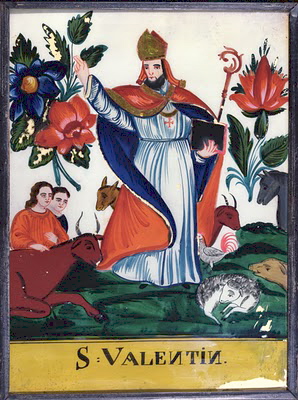
Who was St. Valentine?


Search
: saint valentine

Why: It's coming. Pressure pressure pressure! (aka pizza, cuddling, and a "Veronica Mars" marathon)

Answer: Nobody even knows! How about that. There were a bunch of people named Valentine, but nobody knows what they did or why they were even made saints:
The origin of St. Valentine, and how many St. Valentines there were, remains a mystery. One opinion is that he was a Roman martyred for refusing to give up his Christian faith. Other historians hold that St. Valentine was a temple priest jailed for defiance during the reign of Claudius. Whoever he was, Valentine really existed: archaeologists unearthed a Roman catacomb and an ancient church dedicated to Saint Valentine. In 496 AD Pope Gelasius, marked February 14th as a celebration in honor of his martyrdom.
According to The Nuremburg Chronicles (1493) - an illustrated Biblical and world history book - one Roman priest named Valentinus was caught marrying Christian couples who were being persecuted by Emperor Claudius.
He was arrested and imprisoned; while in jail, he wrote a love note to the jailer's daughter, signing it, "From your Valentine." Though Claudius took a liking to him, Valentinus then tried to convert the emperor, who subsequently sentenced him to death. He was beaten and stoned, and then beheaded outside the Flaminian Gate around 269 AD.

Valentine is the Patron Saint of affianced couples, bee keepers, engaged couples, epilepsy, fainting, greetings, happy marriages, love, lovers, plague, travelers, and young people. I love bees.
Source: Catholic.org

The More You Know: Fun facts about V-Day:
  • In 1537, England's King Henry VII officially declared February 14th the holiday of St. Valentine's Day.
  • It may have been invented in an attempt to supersede the pastoral pagan holiday of Lupercalia, observed on February 13 through 15 to avert evil spirits and purify the city, releasing health and fertility. The feast honored Juno, the queen of Roman gods and goddesses, and the goddess of women and marriage.
  • Over $1 billion worth of chocolate is purchased for Valentine's Day in the U.S.
  • Approximately 110 million roses, mostly red, will be sold and delivered within the three-day Valentine's Day time period.
  • Approximately 1 billion Valentines are sent out worldwide each year, according to the U.S. Greeting Card Association. That's second only to Christmas.
  • In addition to the United States, Valentine's Day is celebrated in Canada, Mexico, United Kingdom, France, Australia, Denmark, and Italy.
  • Every Valentine's Day, the Italian city of Verona - where Shakespeare's lovers Romeo and Juliet lived - receives about 1,000 letters addressed to Juliet.
  • In the US, 64% of men do not make plans in advance for a romantic Valentine's Day with their sweethearts.

Tuesday, February 1, 2011

What words can you play in Scrabble with a Q but not U?


Search
: scrabble dictionary q but not u

Why: Chandler is asking. I swear I'm not cheating, everyone I'm currently playing. I don't even have any Qs (except in one of the games [but which one!!!]).

Answer: There are several! Here's a list (though Scrabble dictionaries may vary, so check before you play):
ANTIQ (an accepted abbreviation for the words “antiquary” and “antiquarian")
BURQA (garment worn by Islamic women)
BURQAS (plural of BURQAS)
FAQIR (Muslim or Hindu monk)
FAQIRS (plural of FAQIR)
MBAQANGA (a style of South African music)
MBAQANGAS (plural of MBAQANGA)
QABALA (occult or secret doctrine, variation of CABALA)
QABALAH (variation of CABALA, QABALA)
QABALAS (plural of QABALA)
QABALAHS (plural of QABALAH)
QADI (Islamic judge)
QADIS (plural of QADI)
QAID (a Muslim tribal chief or senior official)
QAIDS (plural of QAID)
QANAT (gently sloping underground tunnel for irrigation)
QANATS (plural of QANAT)
QAT (leaf of the shrub Catha edulis)
QATS (plural of QAT)
QI (a circulating life energy in Chinese philosophy)
QIS (plural of QI)
QINDAR (Albanian currency, variation of QINTAR)
QINDARKA (plural of QINDAR)
QINDARS (plural of QINDAR)
QINTAR (Albanian currency)
QINTARS (plural of QINTAR)
QIVIUT (musk-ox wool)
QIVIUTS (plural of QIVIUT)
QOPH (19th letter of the Hebrew alphabet)
QOPHS (plural of QOPH)
QWERTY (the traditional configuration of computer keyboard keys)
QWERTYS (plural of QWERTY)
SHEQALIM (plural of SHEQEL)
SHEQEL (any of several ancient units of weight)
SUQ (variant of souk; a marketplace in Arab cities)
SUQS (plural of SUQ)
TALAQ (a method of divorce in Islamic law)
TRANQ (sedative)
TRANQS (plural of TRANQ)
TSADDIQ (Hebrew term for a spiritual leader)
TZADDIQ (Hebrew term for a spiritual leader)
UMIAQ (a boat made of stretched animal skins by Inuits)
Source: Boardgames.about.com, YourDictionary, Scrabble Lookup, ScrabbleFinder

The More You Know: Do you know the band Q and Not U? I saw them once playing at Hamilton College (in Clinton, NY), which is right by (and almost identical to) Colgate (which is in Hamilton, NY). Here is their best song, "Soft Pyramids." Spell it out!

Monday, January 31, 2011

How much was was 7 guineas worth in 1837?


Search
: english money

Why: In the song "Boy for Sale" from Oliver! (at 1:05):
Boy for sale, he's going cheap
Only seven guineas
That or thereabout

Boy for sale for one thousand pennies
You can work it out
That's four pounds, three and four
Slightly under four guineas
-Knocked down from seven guineas
-Three pounds, ten shillings
-Three pounds WHAT, sir? Certainly not siiiiiiiir
Shrug!

Answer
: Well, first, some history:
Until 15th February, 1971, Great Britain had much more interesting system of money, known as the pounds, shillings and pence system, or Lsd - the L coming from the latin word libra, the d coming from the latin word denarius (a Roman coin). The penny has been the basic unit of currency from about 775. In 1971, the system was changed to follow the Russian model - the pound being divided into 100 'new' pennies. Inflation followed...
So before 1971:
  • 12 pence = 1 shilling
  • 20 shillings = 1 pound
  • 240 pence = 1 pound
But now:
  • 100 pence = 1 pound sterling (pound, GBP, £)
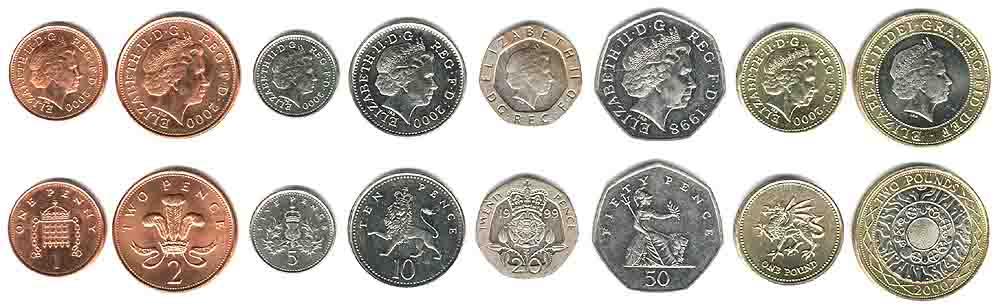
  • Current coins are:
1 penny
2 pence
5 pence
10 pence
20 pence
50 pence
1 pound
2 pounds
  • Current bank notes are:
5 pound
10 pound
20 pound
50 pound
  • Old money and conversions are:
1/2 penny (ha'penny)
6 pence (sixpence or tanner) = 2 1/2 p
1 shilling (bob) = 5 p
1/2 crown (2 shillings & sixpence) = 12 1/2 p
1 crown = 5 shillings
1 guinea = 21 shillings or £1.05
  • But there were also:
Farthing = 1/4 penny, last made in 1956
2 pence (tuppence) - only made in 1797
3 pence - known as a "threpney bit"
Groats = 4 pence (fuppence), made 1836-1888
Florin = 2 shillings (2 bob bit), made 1849-1971
1/2 sovereign = 10 shillings
1 sovereign = 1 pound
The guinea was introduced in 1663, made in gold obtained from Guinea (Ghana) in Africa, its value being fixed at 21 shillings in 1717 (before that date, its value depended on the current price of gold).

The florin was introduced in 1849 as a first step towards decimalization, which took another 122 years to implement.
The coins of 1849 said 'one florin' and 'one tenth of a pound' on the reverse (tail). They were known as the 'godless' type, as they didn't say Dei Gratia on them.
Anyway, back to Oliver! So in 1837, when the book was written,
  • if 1 guinea = £1 - 1s
  • then 7 guineas (the original asking price) was £7 - 7s
According to this thing that I can't really figure out, that comes out to
  • £7 - 7s (1937) = £554 (2009)
  • and £554 = something like $880 (today)
And the offer that Mr. Bumble scoffed at:
  • £3 - 10s (1837) = £264 (2009)
  • and £264 = something like $420
That is pretty cheap, I guess.

Source
: English Weights and Measures, Understanding the British Pound Money, Measuring Worth

The More You Know: Fun fact: The £ sign is shifted above the 3 on an English keyboard. What's above the 3 on an American keyboard?

Saturday, January 29, 2011

What's the song playing during Faust in "Tombstone"?


Search
: tombstone

Why: That same music plays on every disc of the audiobook of The Graveyard Book by Neil Gaiman. Maybe it is a Faust thing? I guess it would make sense, whatwith the Devil and graves and whatnot.

Answer: It's called "Danse Macabre"! Maybe you have heard it:

It was written by French composer Camille Saint-Saëns and first performed in 1872.
According to legend, "Death" appears at midnight every year on Halloween. Death calls forth the dead from their graves to dance their dance of death for him while he plays his fiddle represented by a solo violin with its E-string tuned to an E-flat in an example of scordatura tuning. His skeletons dance for him until the rooster crows at dawn, when they must return to their graves until the next year.
The piece originally had words, too, by French poet Henri Cazalis, "based in an old French superstition." Saint-Saëns later reworked everything and changed the vocal line to a solo violin, but here is an excerpt (in translation obvi):
A lustful couple sits on the moss
So as to taste long lost delights.
Zig zig, zig, Death continues
The unending scraping on his instrument.
A veil has fallen! The dancer is naked.
Her partner grasps her amorously.
The lady, it's said, is a marchioness or baroness
And her green gallant, a poor cartwright.
Horror! Look how she gives herself to him,
Like the rustic was a baron.
Zig, zig, zig. What a saraband!
They all hold hands and dance in circles.
Sassy!

Source
: IMDb

The More You Know: Not at all coincidentally, Chapter 5 of The Graveyard Book is called "Danse Macabre." One night, some of the dead folk and some live folk have a little get-together and chant stuff like this:
Time to work and time to play,
Time to dance the Macabray.

One to leave and one to stay
And all to dance the Macabray.

Rich man, poor man, come away.
Come to dance the Macabray.

One and all will hear and stay
Come and dance the Macabray.

Step and turn, and walk and stay,
Now we dance the Macabray.
Anyway, I just found out here that Bela Fleck does the ones on the audiobook. Fun!

Friday, January 28, 2011

How did the novel "I Am Legend" end?


Search
: the omega man; i am legend

Why: In "Changed film endings": [spoiler alert, durr]
I Am Legend

The end of Will Smith's apocalyptic blockbuster sees his character Robert Neville sacrificing himself to ensure his companions get the cure for a deadly virus that has plagued the world. As endings go for a Will Smith action blockbuster it's darker than usual and not the feelgood one studio bosses would have preferred to give their audience. However, it's the ending that was suggested after the original denouement received negative feedback at test screenings.

The original climax, aping the message from the classic book that it was based on, had Neville realising at the end that he was in fact the problem. The 'vampires' had been trying to rescue the creature that he had kidnapped earlier in a bid to find a cure. Will Smith as the bad guy. Not very satisfying for his fans.
Answer: Like they said! First, he finds that other girl and bangs her. The following morning:
Ruth agrees to let him take a blood test on her. She knocks him out just as he realizes she is infected. When he wakes up, Neville discovers a note left by Ruth. In it, she tells him that the infected have slowly been able to adapt to their disease to the point where they can spend short periods of time in sunlight, and they are even attempting to rebuild society. They fear and hate Neville since he has unwittingly destroyed some of their people along with true vampires (dead bodies animated by the 'germ') during his daytime excursions and view him as a predator. In their quest to capture him, the infected sent one of their own to Neville.

Neville meets Ruth again in his prison; she informs him that she is a ranking member of this new society, but unlike the others, she doesn't fear and hate him. She tells him she had come to his prison to try and help him escape, but that is now impossible. She acknowledges the need for Neville's execution and slips him pills, claiming they will 'make it easier.' Emotionally broken, Neville finally accepts his fate and tearfully asks Ruth not to let this society get too brutal and heartless. Ruth kisses him and leaves.

Neville goes to his prison window and gets a glimpse of all the infected milling around in the yard, waiting for his execution. When they spot him, he sees the fear, awe and horror in their eyes, and he understands to them, he is a scourge, just as they were a scourge to him at the beginning of the novel. Previously, Neville saw the destruction of the infected survivors as a right and a moral imperative to be pursued for his own and mankind's survival, but now, he finally acknowledges defeat. He is the only known immune human left in the world, the only survivor of the "old race."

He glimpses a future society where infection is normal and he, Neville, is a murderous biological deviant. As he turns away and swallows the pills, Neville grasps the reversal that has taken place: that just as vampires were legend in pre-infection times, now he, an obsolete exemplar of old humanity, is legend in the eyes of the new race born of the infection. The sheer ridiculousness of it all causes Neville to chuckle as he dies, his last thoughts being "[I am] a new superstition entering the unassailable fortress of forever. I am legend."

Crazy!

Remember that sad sad scene with the dog? Also, have you seen any of the other 3 adaptations that are probably way better? I haven't.
Source: Wikipedia

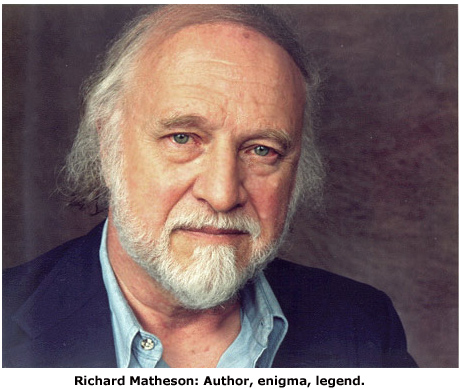
The More You Know: The guy that wrote the novel is Richard Matheson, aka Logan Swanson. He also wrote the novels What Dreams May Come and The Shrinking Man and the screenplays for The Last Man on Earth (a 1964 I Am Legend adaptation) and The Incredible Shrinking Man (1957). He also wrote a bunch of "Twilight Zone" episodes and the 1983 feature film, and a shitton of other things, too. One of his sons wrote a bunch of episodes of "The A-Team" and "The Torkelsons,"* and another one wrote both Bill & Ted's Excellent Adventure and Bill & Ted's Bogus Journey, which just happens to be my favorite movie. His daughter is also a prolific writer.

*If you are someone I know and you also watched "The Torkelsons," please let me know right away.